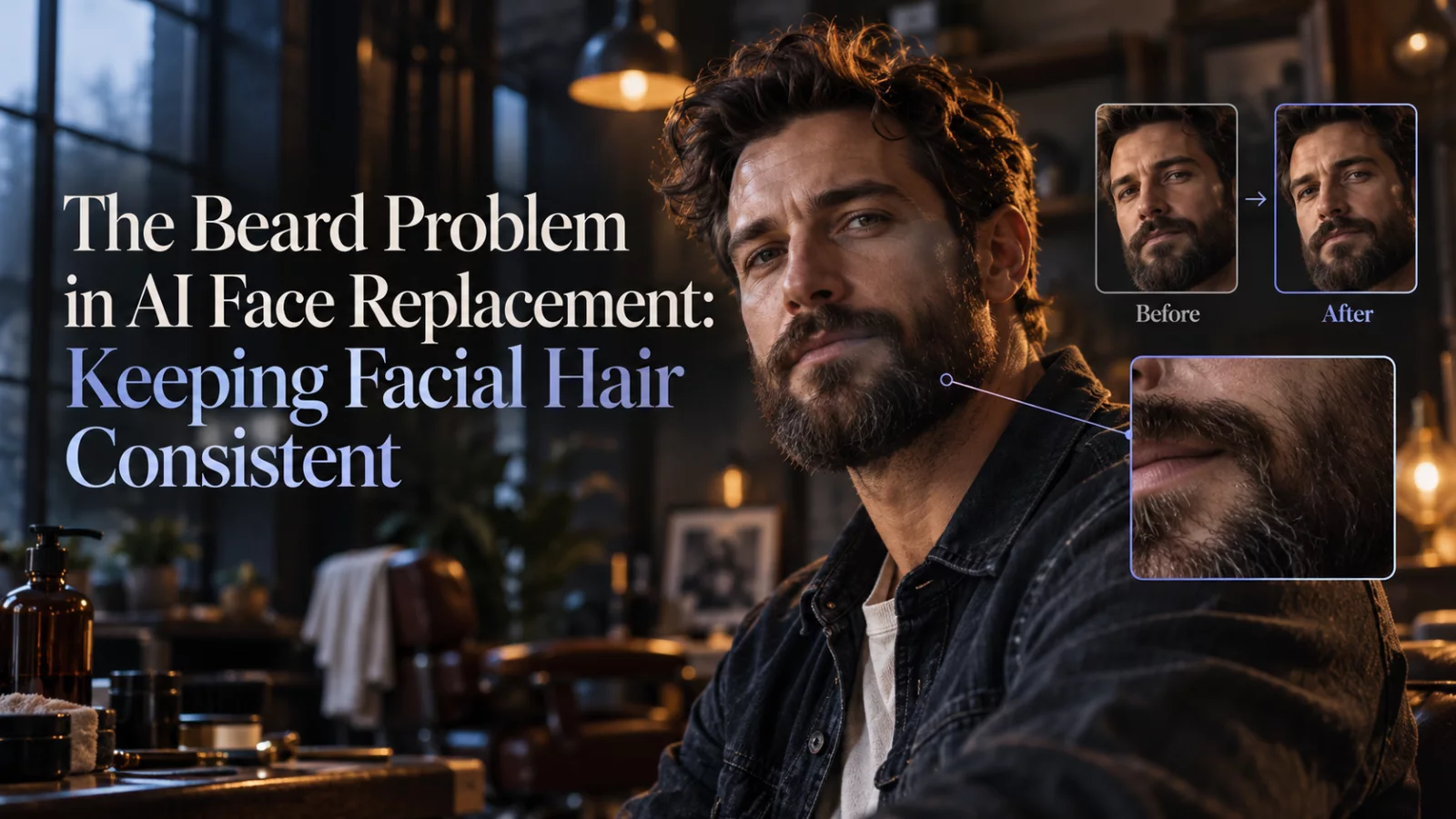
Facial hair is one of the quickest ways to spot a weak face replacement. You upload a clean-shaven portrait, but the finished character still has the actor's original mustache. Or you upload someone with a full beard and the model produces an oddly smooth jaw.
The issue is that video-to-video tools often preserve the original actor's motion, lighting, and parts of the head. Beard texture sits at the boundary between identity, clothing-like appearance, and moving facial detail. A model may try to keep both identities at once.
Decide whose beard should win
There are two reasonable goals, and they require different prompts.
If you want a true identity replacement, the uploaded person should determine whether a beard exists. Say so explicitly: “Use the reference image for facial-hair presence, shape and color. Do not inherit beard or mustache from the source actor.”
If you are making a stylized character edit that should preserve the actor's original beard, say that instead. The important part is choosing one rule. “Preserve everything” and “replace the whole face” can conflict.
Why a face-only crop sometimes looks pasted on
A beard changes the silhouette of the chin and the lower cheeks. Replacing only the eyes, nose, and mouth may leave an obvious seam below the lips. Good blending needs the entire jawline, lower face, and neck transition to look physically connected.
Use a reference in which the chin is visible. Avoid portraits cropped at the mouth, heavy smoothing filters, and hair covering the jaw. When you inspect the render, pause during speech rather than only at neutral expressions. Mouth movement exposes blending mistakes.
Practical retry order
First, use a sharper reference with the correct beard state. Second, simplify your prompt so beard ownership is unambiguous. Third, test the shortest segment that contains a close-up. Only after those checks should you consider generating at a more expensive quality level.
Beards are not just a cosmetic detail: they anchor the face's proportions. Treating them as part of the identity makes the output look less like a sticker pasted over a moving actor.