
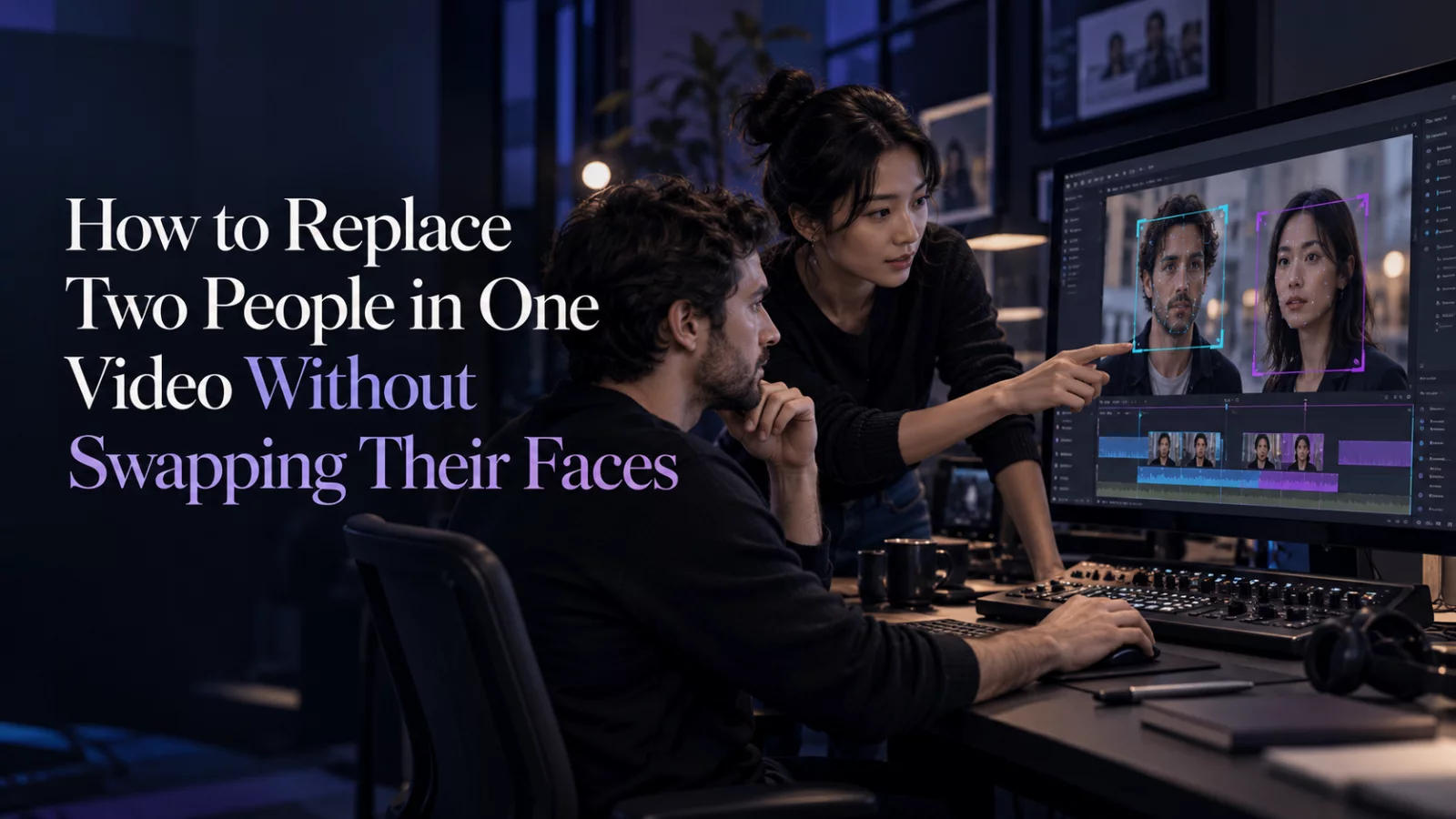
Two-person video edits are deceptively difficult. You have two uploaded photographs, several people appearing on screen, and a model trying to decide who belongs to whom. If the instructions are vague, the result may put the right faces on the wrong actors.
Start by naming the roles, not the photos
Write down a simple identity map before touching the generation button:
- Reference image 1 → Character A: the older speaker in the blue jacket, visible at the beginning and end.
- Reference image 2 → Character B: the long-haired speaker in the middle exchange.
- Everyone else: unchanged.
The costume, hairstyle, position and speaking moment in those descriptions identify the source characters. They are not instructions to copy the appearance of the replacement photos. That distinction matters when a replacement has very different hair or glasses.
Give the model something it can locate
“Swap the two main people” is a weak instruction when a scene includes three or four faces. Better targeting combines several clues: what each actor wears, where they stand, and when they speak. A useful prompt is:
Image 1 replaces only the older speaker who appears first and returns at the end. Image 2 replaces only the long-haired speaker in the middle. The person standing behind them remains unchanged. Never exchange the two uploaded identities.
Avoid long passages about cinematic quality until the role mapping works. Every extra creative instruction competes for the model's attention.
Test on the crowded part, not the easy part
A one-person frame proves very little about a two-person edit. Review the instant when both targets appear together or when a non-target walks between them. The model should preserve each identity even as faces overlap or a character briefly leaves the frame.
If a mistake happens at the same time every generation, your source may need a more precise temporal cue or a better-suited editing model. If the wrong person changes at random, try simplifying the prompt and choosing identity references with clearer faces.
A final quality checklist
Check all three classes of faces: Character A, Character B, and people who should never change. The third group is easy to overlook, but it is where many seemingly successful edits fail.
For a broader explanation of the technique, read how AI face replacement works. And if the source is too busy to map reliably, sometimes a simpler scene is a better choice than another expensive render.